Elly Kuch
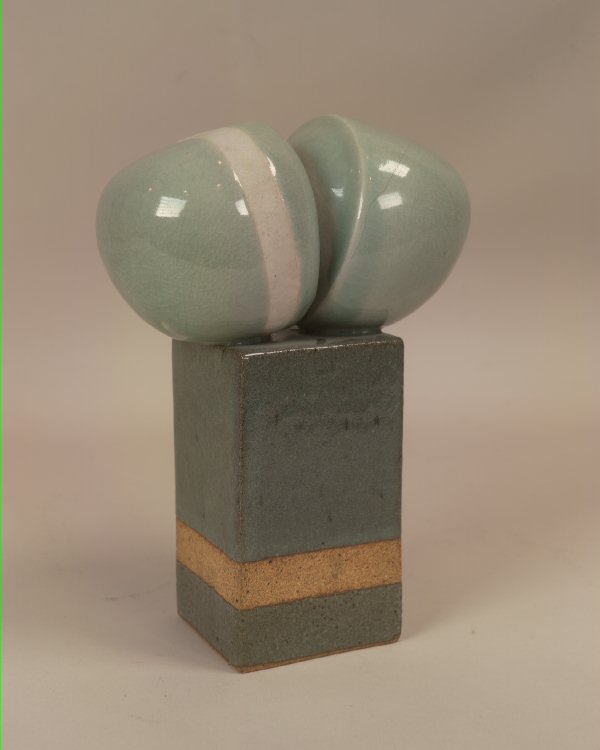
(1929-2008) born and lived in Nuremberg, Germany
Object, 1973
clay, 10.75 x 7.5 x 4.5 inches, 93.39.269
Elly Kuch and her husband, Wilhelm, made a great partnership as ceramic artists. Playing to each other’s strengths, Elly would construct the clay forms, and Wilhelm would do the surface glazing and firing, and they would both mark the work. Together, they operated a popular workshop in Burgthann outside of Nuremberg from 1951-1990, exhibiting many vessels, wall designs, and sculptures across Germany. In 1966 they were the first Germans to win the prestigious Faenza Prize in Ceramics, which is one of the longest-standing international ceramic competitions as well as one of the highest recognitions one can receive in the field of ceramics, an honor that Elly and Wilhelm won again in 1973.[1]
In the spring of 1971, under the auspices of the International Academy of Ceramics, the Tennessee Arts Commission pledged its support for the promotion and establishment of the U.S. International Ceramic Symposiums. The Symposium’s mission to help develop a worldwide network of support for ceramic art was achieved by bringing together top ceramic artists from around the world for a month-long sharing of ideas and creation of innovative ceramics.
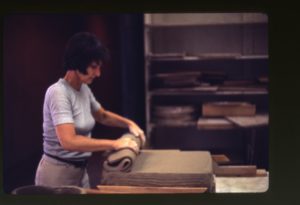
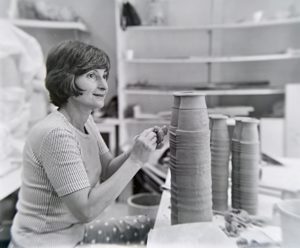
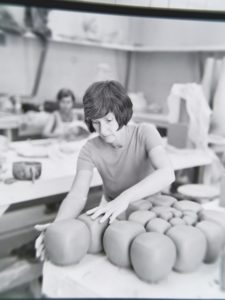
Left: Kuch rolling clay, TN Arts slide, Center and Right: photos courtesy of Lewis Snyder Additional images below
Elly represented Germany at the First U.S. International Ceramic Symposium, which consisted of twenty-five artists from thirteen different countries, and was hosted in the summer of 1973 at the Memphis Academy of Art. While at the Symposium, she created a variety of work, including a series of hand built cups, a few large vases, and several abstract sculptural forms.
Elly and Wilhelm have won a number of awards, including a gold medal at the 1973 Ceramics International in Calgary, Alberta, Canada. They have work in the collections of the Museum Boijmans, The Netherlands; the International Ceramics Museum in Weiden, Germany, and at the Kunstmuseum Hersbruck in Hersbruck, Germany. In 1983 they were founding members of Gruppe 83, a coalition of German ceramicists within the International Academy of Ceramics. Elly kept creating ceramics works until she passed away in 2008.
Elly considers her work more as forms than as sculpture. She thinks it is very important to see different ways or working in ceramics. She and her husband, Wilhelm, are now working with a gas kiln and reduction firing which she feels is, for them, “a new beginning in ceramics.” – 1973 International Ceramic Symposium catalogue
[1] “Premio Faenza.” Museo Internazionale delle Ceramiche in Faenza. Retrieved from http://www.micfaenza.org/en/concorso-internazionale-premio-faenza/
Written by Aiden Layer, TN Arts Intern
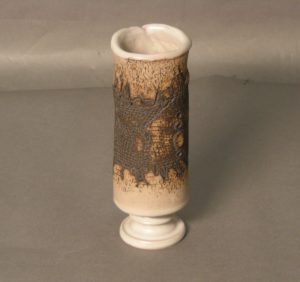
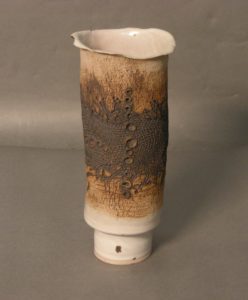
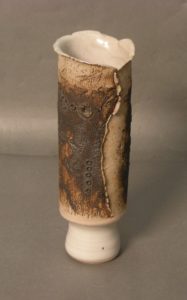
Left: Cup, 1973, stoneware, 6 x 2 x 2 inches, 93.39.116 Center: Cup, 1973, stoneware, 7.25 x 3 x 2.75 inches, 93.39.125 Right: Cup, 1973, stoneware, 7.25 x 2.75 x 2.5 inches, 93.39.126